THE PREPARATION LIBRARY / FIELD EDITION
The Interview Workbook
Practice original scenarios, develop your story bank and explain your decisions.
25 pages · $49 planned one-time price
The work you will leave with.
A story bank, worked role plays and two structured mock interviews.
For U.S. candidates preparing applications and interviews. Work with your own facts and a current role description. Examples are fictional educational material.
THE RIGHT READER
Choose this book when…
You have a target role and need to develop specific answers, rehearse follow-up questions and practice unfamiliar scenarios.
Bring a role description and a few real achievements. Build a story bank, rehearse the role plays and use the mock sessions to identify revisions.
TRY A FIRST STEP
Do this before buying.
Choose one result. Explain your responsibility, the action you took and what changed. Then answer: what would you do differently?
Try the free interview promptsINSIDE THIS EDITION
25 pages. A concrete preparation file.
This edition has 12 chapters and a 5-page excerpt. Original fictional cases connect the chapters to the editable companions.
- Turn the posting into an agenda
- Build six evidence stories
- Explain motivation and transition
- Discover before you demonstrate
- Work with different stakeholders
- Respond to objections with evidence
- Prepare a product-research presentation
- Three progressive role plays
- Prepare for the format you are actually given
- Thirty original practice prompts
- Two structured mock interviews
- Debrief, revise and repeat
Files in the current package
- interview-workbook-edition-01.pdf
- companions/mock-feedback.csv
- companions/practice-log.csv
- companions/presentation-outline.md
- companions/product-source-card.csv
- companions/README.md
- companions/story-bank.csv
The PDF opens in a standard PDF reader. CSV companions can be edited in spreadsheet software. Extract the ZIP before working with your copies. No account or email is needed for the excerpt.
READ BEFORE YOU BUY
A real excerpt from this edition.
Preview page 1 of 5. Use Enlarge page for a closer view. When the page is focused, use left and right arrows to change pages.
Read the complete free sample as text (5 pages)
Text from the same public sample shown above. Use the page images or PDF for diagrams, equations and original layout.
Sample page 1
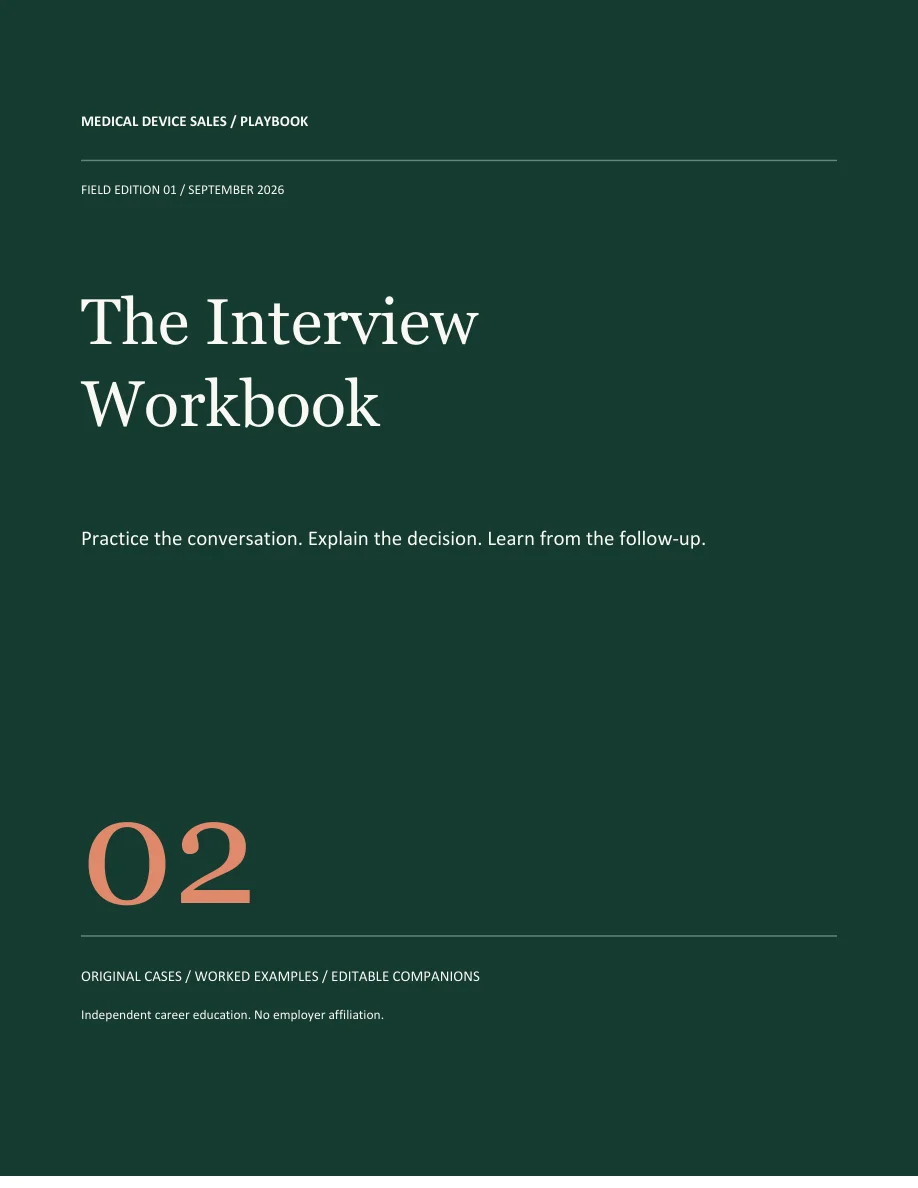
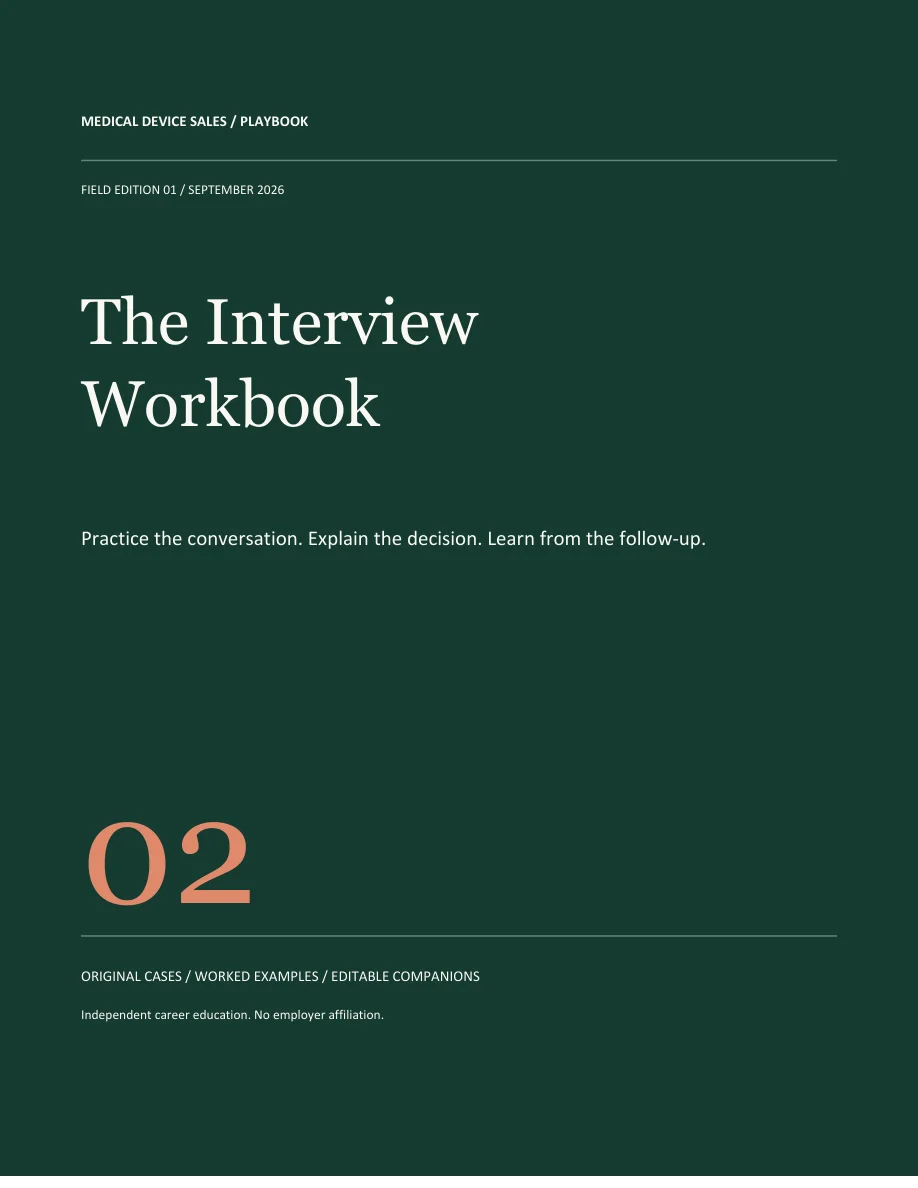
MEDICAL DEVICE SALES / PLAYBOOK FIELD EDITION 01 / SEPTEMBER 2026 The Interview Workbook Practice the conversation. Explain the decision. Learn from the follow-up. 02 ORIGINAL CASES / WORKED EXAMPLES / EDITABLE COMPANIONS Independent career education. No employer affiliation.
Sample page 2
MEDICAL DEVICE SALES PLAYBOOK FIELD EDITION / 02 Original educational material 2 CONTENTS Your route through the work 4 01 / Turn the posting into an agenda 5 02 / Build six evidence stories 6 03 / Explain motivation and transition 7 04 / Discover before you demonstrate 9 05 / Work with different stakeholders 11 06 / Respond to objections with evidence 13 07 / Prepare a product-research presentation 15 08 / Three progressive role plays 17 09 / Prepare for the format you are actually given 18 10 / Thirty original practice prompts 22 11 / Two structured mock interviews 24 12 / Debrief, revise and repeat
Sample page 3
MEDICAL DEVICE SALES PLAYBOOK FIELD EDITION / 02 Original educational material 3 How to use the workbook Practice from notes, not a memorized speech. Write your first answer before reading the commentary, then ask someone to challenge one assumption or request one concrete example. Keep the first version: the difference between attempts shows what you learned. These are original educational exercises for U.S. candidates. They are not actual questions supplied by an employer. Northline Devices, the accounts, products and candidate details in the cases are fictional. No product-performance or clinical claims are established by the cases. Use your own evidence in applications and follow the instructions of the employer whose process you are in. The workbook produces an evidence bank, a discovery agenda, a presentation outline and two mock-interview records. You can complete it alone by writing the follow-up answers, but a partner can reveal unclear reasoning that feels obvious in your own head. The rubrics identify revisions; they do not predict hiring outcomes. If an exercise requires information that you do not have, say so. Then explain how you would obtain it. The objective is a defensible response, not the appearance of knowing every answer.
Sample page 4
MEDICAL DEVICE SALES PLAYBOOK FIELD EDITION / 02 Original educational material 4 FIELD NOTES / 01 01 / Turn the posting into an agenda Prepare for responsibilities Read the current job description and identify the work the employer wants done. List the evidence you have for each central responsibility. Then prepare a question for anything ambiguous. The same story can support several responsibilities, but it should answer the question you were asked rather than become a speech you deliver regardless of context. Employer materials distinguish associate, territory and clinical-sales work. Some roles combine customer education with commercial support. That variation is why this workbook asks you to begin with the posting instead of a universal medical-sales script. [S1-S2] Worked agenda Fictional Northline Devices is interviewing an associate candidate. The brief emphasizes learning an unfamiliar portfolio, supporting the territory team and communicating reliably. It gives no independent-revenue target and no promise of immediate promotion. The candidate's preparation agenda includes a learning example, a coordination example and a time feedback changed their work. It also includes questions about training, supervision and the responsibilities that follow successful onboarding. A story about personally owning a large territory would be unsuitable if the candidate never did that work. For an experienced seller, the agenda changes. Keep the learning questions, but add account prioritization, personal contribution to results and how an opportunity was advanced. The change comes from the role's responsibilities, not from a desire to sound more senior. Practice Complete three rows: responsibility, evidence story and unresolved question. Ask a partner to choose one row without warning. Explain its story in a short answer, then respond to “What exactly did you do?” If the answer becomes vague, the next step is better evidence rather than more rehearsal.
Sample page 5
MEDICAL DEVICE SALES PLAYBOOK FIELD EDITION / 02 Original educational material 5 FIELD NOTES / 02 02 / Build six evidence stories A story card is a retrieval aid Create a card for a win, a setback, a difficult conversation, a learning task, a coordination problem and feedback you used. These categories are an editorial practice tool, not a claim that every employer uses six categories. Each card has context, objective, your decision, action, result, limitations and what you would change. Write fragments rather than paragraphs. That leaves room to adapt the answer to the question. If the result is not numerical, explain the observable outcome without inventing a number. Worked card: an account stalls Fictional B2B seller Maya had a customer interested in a commercial-service proposal. The customer stopped responding after the initial meeting. Maya discovered that an operational requirement had not been resolved. She arranged a discussion with her operations colleague and the customer's contact, clarified the requirement and agreed the information needed before the customer could decide. The result in this example is a clarified next step, not a closed sale. A useful answer might be: “I initially treated interest as progress. When the conversation stalled, I asked what still needed to be resolved. I learned there was an operational question I had not brought into discovery. I involved the right colleague and recorded a specific next step. I would raise that dependency earlier next time.” This answer works because the lesson follows from the action. A weaker version would turn the unresolved opportunity into a win or describe persistence as the only solution. Ownership correction “We solved the customer's problem” is incomplete when the interviewer is asking about you. Explain your contribution and the team's contribution separately. “I identified the unresolved question and organized the discussion; my operations colleague supplied the technical answer” is precise. You do not need to claim all the work to demonstrate value. Knowing when to involve another person is itself a useful behavior when accurately described. Practice For each story, write one difficult follow-up. Examples: “How do you know the result?”, “What did your colleague do?”, “What would the customer say?” and “What remained unresolved?” Then remove any statement you cannot support.
Know the scope.
Original practice material, not leaked employer questions or a verified interview script. No live coaching or individual answer review is included.
Personalized resume review is a separate service. Inspect the sample review.
Work with the companions.
Keep the original files, duplicate a working copy and replace the fictional inputs with your own supported evidence. Use a spreadsheet editor for CSV files and a text editor for Markdown files.
Compare all three booksBefore you decide
What would help you choose?
Start with the question that matters to you. You can use the free material without making a purchase.
Can I start with something free?
Try one relevant task first. If that resolves your immediate question, keep using the free resources. Inspect the book’s sample when you need more structured practice.
Try the free interview promptsHow would I put this to use?
A story bank, worked role plays and two structured mock interviews.
- Choose one relevant example or exercise from the sample. Write your own attempt before reading its explanation.
- Compare your approach with the explanation. Note a specific assumption, missing fact or step you would change.
- Revise your attempt, then revisit it in a later session without the explanation open.
Use this as a self-study routine, adjusting it to the material. Completing a session is not a certification or an assessment of hiring readiness.
One book, a bundle, or personal feedback?
Choose one book for a focused gap. Consider a bundle only if you will use its listed books; compare the exact contents and avoid paying twice for material you already own.
A PDF is self-directed preparation. Individual feedback on your own resume is a separate service with its own scope and availability.
Compare the resume serviceWhat should I check before paying?
Check the current price, included files, delivery instructions and refund terms before opening checkout.
Read the actual sample and file details on this page. If you need help with an order or access, contact support with your question rather than placing a second order.
Read purchase and refund termsAsk a product or access question